Pre-5.6 Firmware Specifics
This section gives summary descriptions of features that came out with firmware versions prior to the current 5.7.x release.
Firmware 5.4.3: YubiHSM Auth
YubiHSM Auth is a CCID application that can store long-lived credentials (AES keys) that are used to establish secure sessions to a YubiHSM 2. By providing an external challenge, a derivation scheme that yields three session keys is executed. The session keys are not stored on the YubiKey but simply output as a result. The session keys can be used for authentication to the YubiHSM 2. The authentication scheme is based on SCP03 (see Firmware 5.3.0: Secure Channel above). Each long-lived YubiHSM Auth credential is protected by a user access code that has to be provided to authenticate each session. Storing and deleting credentials requires a separate admin access code.
For detailed information, see YubiHSM Auth Specifics.
Benefits and Usage
YubiHSM Auth enables the secure storage of the long-lived credentials for accessing a YubiHSM 2. The existing authentication solution for the YubiHSM 2 is based on software credentials derived from the Password-Based Key Derivation Function 2 (PBKDF2) algorithm with a password as input.
Generating keys using PBKDF2 is just for convenience. It is preferable - and recommended - to provide AES keys directly to avoid exposing them to attack. Not only is it important to avoid losing the derivation password or the keys themselves (as those are basically the same thing), but those credentials also
- Exist outside a secure element and
- Need to be given in clear text to the program that uses them loads them into memory.
With YubiHSM Auth only the ephemeral session keys exist outside a secure environment.
Firmware 5.3.0: Secure Channel
Secure channel is used for establishing an authenticated and encrypted communication channel over CCID between a host and the secure element on the YubiKey. The YubiKey security domain can store three concurrent long-lived transport key sets.
SCP03 (Secure Channel Protocol 03), which is part of the GlobalPlatform standard, is a framework for mutual authentication and encrypted transport between hosts and secure elements in smart cards. This protocol for secure channel is implemented on YubiKeys as of Yubico 5.3.0 firmware.
For detailed descriptions of the secure channel feature refer to Yubico Secure Channel Technical Description, Yubico Secure Channel Key Diversification and Programming, and Yubico SCP03 Developer Guidance.
Note
Applications based on PKCS #11 or Microsoft CNG do not usually use the secure channel.
Benefits and Usage
- Encryption application keys can be stored on the CMS server as well as on the YubiKey. If the YubiKey is lost or compromised, the encryption key can be recovered and loaded onto a replacement YubiKey.
- Key diversification enables simplified and secured distribution of secure channel transport key sets as only the BMK must be shared with the CMS system to derive the YubiKey transport key sets.
- The secure channel transport key sets can be preprogrammed at the YubiKey batches by Yubico, if the Yubico supply chain has access to the BMK of the CMS vendor.
- The CMS system can generate the secure channel transport key sets based on the YubiKey serial numbers, the BMK, and additional metadata. The CMS can then use the initial secure channel transport key set for writing additional secure channel transport key sets to the YubiKeys.
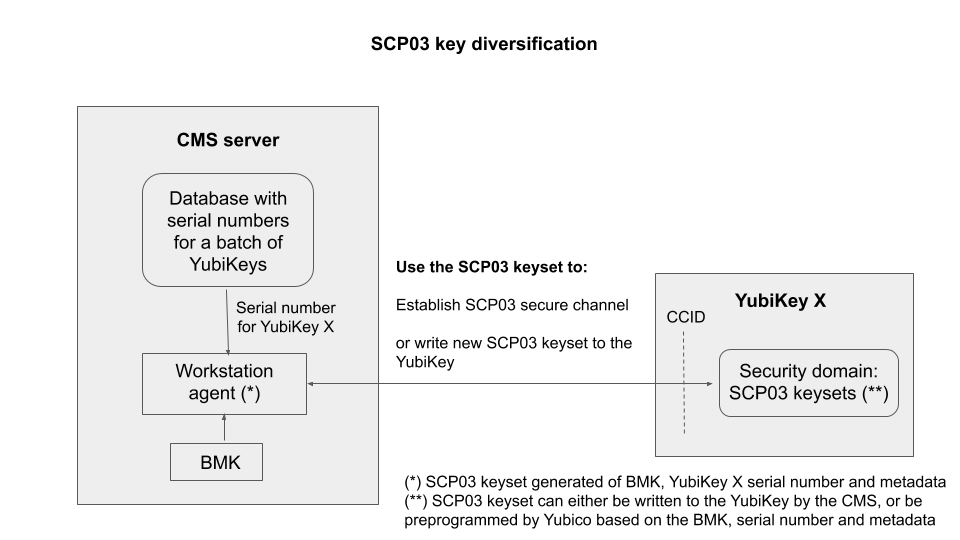
SCP03 Key Diversification
For more technical information, see Yubico Secure Channel Key Diversification and Programming.
Firmware 5.3.0: NFC ID Calculation Changed
Crucial to vendors of physical access control systems and door protection systems utilizing NFC readers, the modification of the YubiKey NFC ID calculation enables NFC readers and access management systems (door locks) using the NFC ID tag to identify NFC-enabled YubiKeys, including those without serial numbers. It is now calculated so that a unique string is returned in the first part of the NFC ID. Until the release of the 5.3.0 firmware, the fact that some access control systems truncate the YubiKey NFC ID meant that YubiKey 5 NFC IDs appeared to be non-unique.
For more technical information on this, see NFC ID Calculation Technical Description.